Labeling & Packaging Solutions Affordable • Reliable • Made in the USA
Technical Education Series
Label Procurement Guide
1. Physical Roll Dimensions
Ensure your rolls are engineered for the physical limits of your Zap Labeler. Exceeding the Maximum Outer Diameter (OD) will cause the roll to rub against the tabletop or chassis.
Zap Labeler Model
Required Core ID
Maximum Roll OD
ZL5 / ZLS
3-Inch Standard
8.0-Inch Max
ZLA / ZLA+ / ZL8
3-Inch Standard
10.0-Inch Safe Recommended; Up to 10.5-Inch May Fit
2. Orientation & Unwind Direction
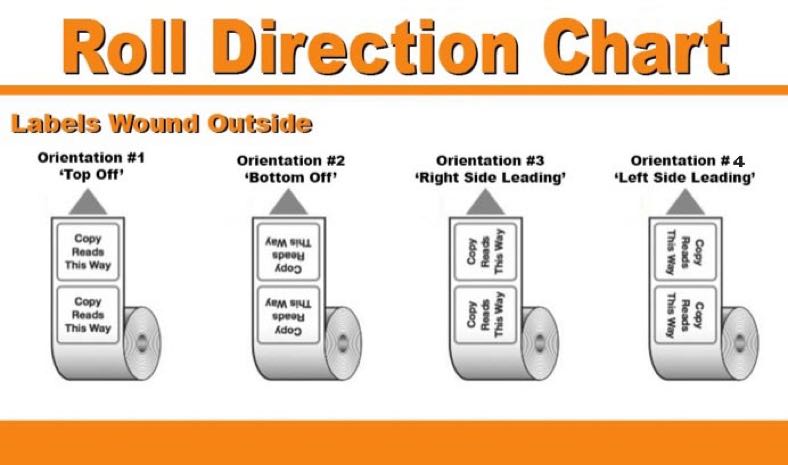
Labels must be wound OUT (Adhesive Side Down). Orientations #5–#8 (Wound In) are incompatible with standard Zap Labeler spindles.
Round Containers
Requires #3 (Right-Edge) or #4 (Left-Edge) leading to wrap correctly around the circumference of bottles or jars.
Non-Round Containers
Utilizes #1 (Top-Edge) or #2 (Bottom-Edge) leading for vertical alignment on pouches, bags, and boxes.
The Carrier Rule
Regardless of the face material, the **Substrate (Liner)** must be a high-quality paper carrier to maintain tension and release speed.
⚠️ UNKNOWN ORIENTATION? Call us at 800-617-5251 to ensure proper orientation before placing your roll order.
3. Professional Ink Technology
Dye Ink (Vibrant)
High resolution and maximum color vibrancy. Best for retail products in dry environments.
Pigment Ink (Resistant)
The industrial standard for durability. Resists water, oils, and UV light.
Dry Toner (Thermal)
Fused with heat for superior scratch resistance. Works across widest variety of substrates.
Inquiry Template Creator
Select your requirements to build a technical inquiry for your vendor.
Frequently Asked Questions
The ZL5 chassis is physically limited to an 8.0" Outer Diameter. A 10" roll will rub against the machine base, preventing the labels from dispensing correctly.
Zap Labelers utilize a "Wound Out" path where the adhesive side faces the rollers. If you use Wound In labels, the adhesive will face away from the container during the application stroke.
Standard 2.4mil to 3.0mil thickness works best. Extremely thick laminates can resist the curvature of round bottles, leading to the edges peeling up.
The ZLA+ uses an IR sensor to detect gaps. Standard sensors cannot "see" clear labels on a clear liner unless they have a "black mark" on the liner.
The liner is the backing paper. Synthetic liners are often too slippery for drive rollers. A high-quality paper liner provides the friction necessary for accurate pulling.